
Autorin: Juno Legat
For english version please scroll down!
Am 7. Workshop am Samstag, 10.10.2026, handelte es sich um eine geteilte Einheit, dessen erste Hälfte ein informativer Vortrag über den jetzigen Stand unseres Weltraums
Die Vortragenden Juliana Neuhuber und Judith Delany, erwähnten ebenfalls, wie sich der Bestand an Weltraumschrott über die Jahre verändert hat, und was in Zukunft passieren wird, wenn wir uns nicht schnellstens etwas einfallen lassen.
Erstere ist aufgewachsen auf der Burg Altpernstein in OÖ. Sie ist Regisseurin und Drehbuchautorin und arbeitet als Filmemacherin und Interaktive Storytellerin für Mixed Medienprojekte in den Bereichen MINT, Space und History. Sie entwickelt Geschichten, Videos und Rätsel für Escape Rooms, Apps und Spiele und baut gemeinsam mit den Corebreaker Labs gamifizierte Hard- und Software Produkte.
2010 gründete sie ihre Firma Traum & Wahnsinn, sowie 2022 das IT- und Datenvisualisierungsunternehmen Impressive Space Development. Eine unserer Kund:innen war die Europäische Weltraumorganisation (ESA), das Technische Museum Wien oder das Bundesforschungszentrum für Wald. Ebenso bin ich Teil der Woman in Aerospace Europe, Austria Chapter.
Zweitere ist Space Communication Expert und Ecosystem Builder. Sie kombiniert ihren Abschluss in Journalismus und Medienkommunikationen mit einem MA in Internationale Beziehungen mit Schwerpunkt Weltraumrecht und -politik, um den Weltraum sichtbarer zu machen und die einzelnen Stakeholder in ihm besser zu verknüpfen. Sie war Marketingleiterin für die Region EMEA “For All Moonkind”, CEO und Founder von Perihelion – The Creative Agency for the Space Sector, und Gründerin und Vorstand der Woman in Aerospace Europa, Austria Chapter.
Der Vortrag
Am Vormittag setzen wir uns mit dem Thema “Nachhaltigkeit im Weltraum”, “Space Traffic Management“ und dem “Kessler-Effekt” auseinander.
Uns wurde Ein Video gezeigt, welches veranschaulichen sollte, wie sehr sich Anzahl an Weltraumschrott um die Erde in den letzten Jahren vermehrt hat, sowie die Gründe, und wie es passiert, dass immer mehr teile herumschwirren.
Dafür gibt es außerhalb des offensichtlichen (Wenn Menschen Satelliten, Messgeräte und Ähnliches in den Orbit befördern) noch das Konstante Geschehnis, dass Teile, die schon da sind, zerbrechen oder miteinander Kollidieren. Das Kann man sich vorstellen, wie radioaktiven Zerfall. Immer weiter zerfallende Teile, die nie wieder Unter Kontrolle zu bringen sind. Zumindest nicht mit unseren heutigen Mitteln oder Methoden; da bis heute niemand auch nur versucht, eine Lösung zu finden, und die dann auch wirklich zu testen und auszuprobieren.
Die rapid ansteigende Zahl an Objekten, die stark in der Größe variieren können, stellen eine Gefahr für alle funktionierenden Geräte in Reichweite da, wie die ISS, Satelliten, Messinstrumente, zukünftige Missionen und so unglaublich viel mehr da.
Vor etwa 100 Jahren war alles noch sehr viel einfacher. Die Erde war noch eine unentdeckte Kugel im Universum und der Weltraum um sie herum unendlich weit. Regeln waren kaum nötig, denn es gab zu wenige Akteure.
Das Planspiel
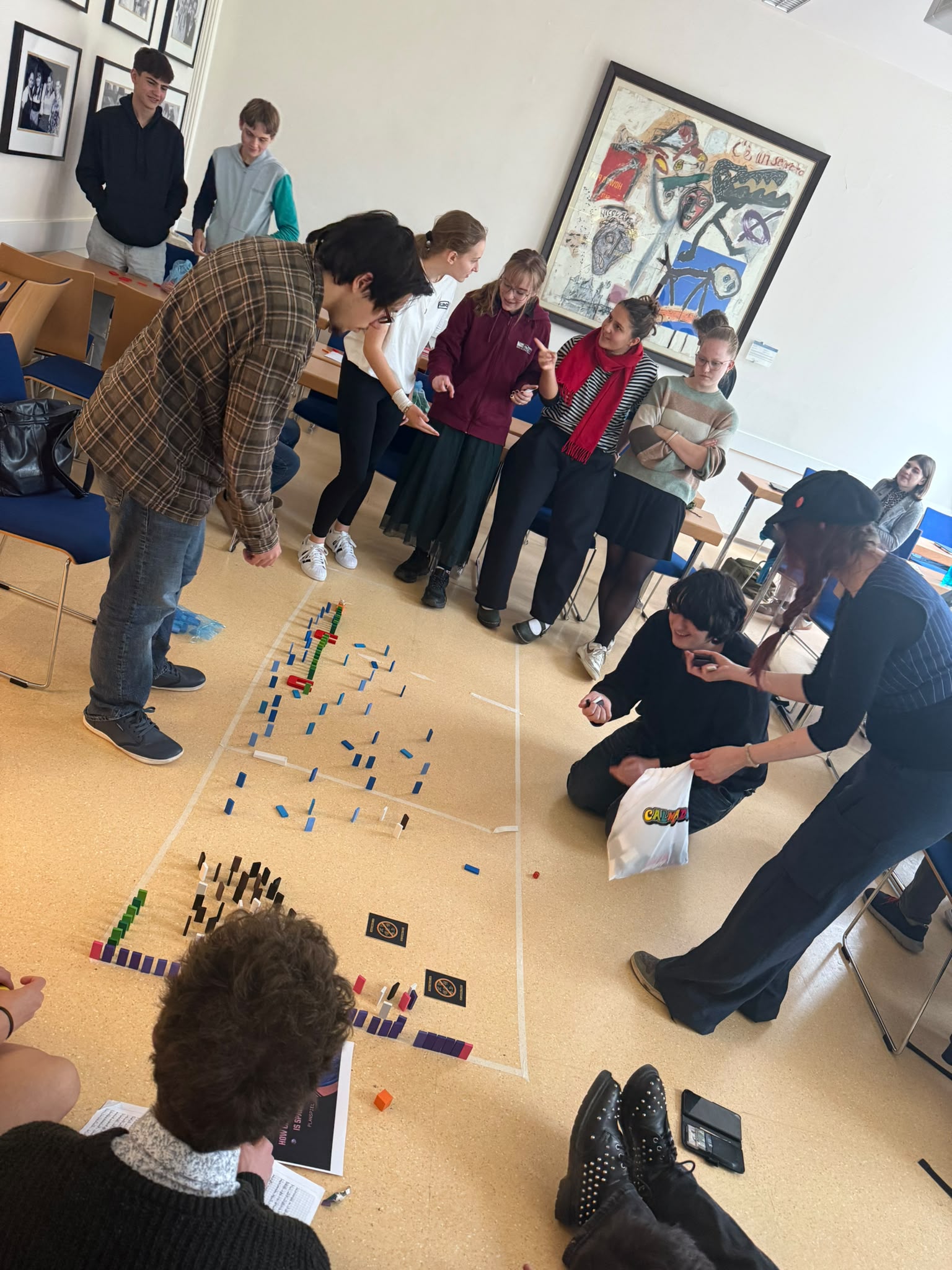
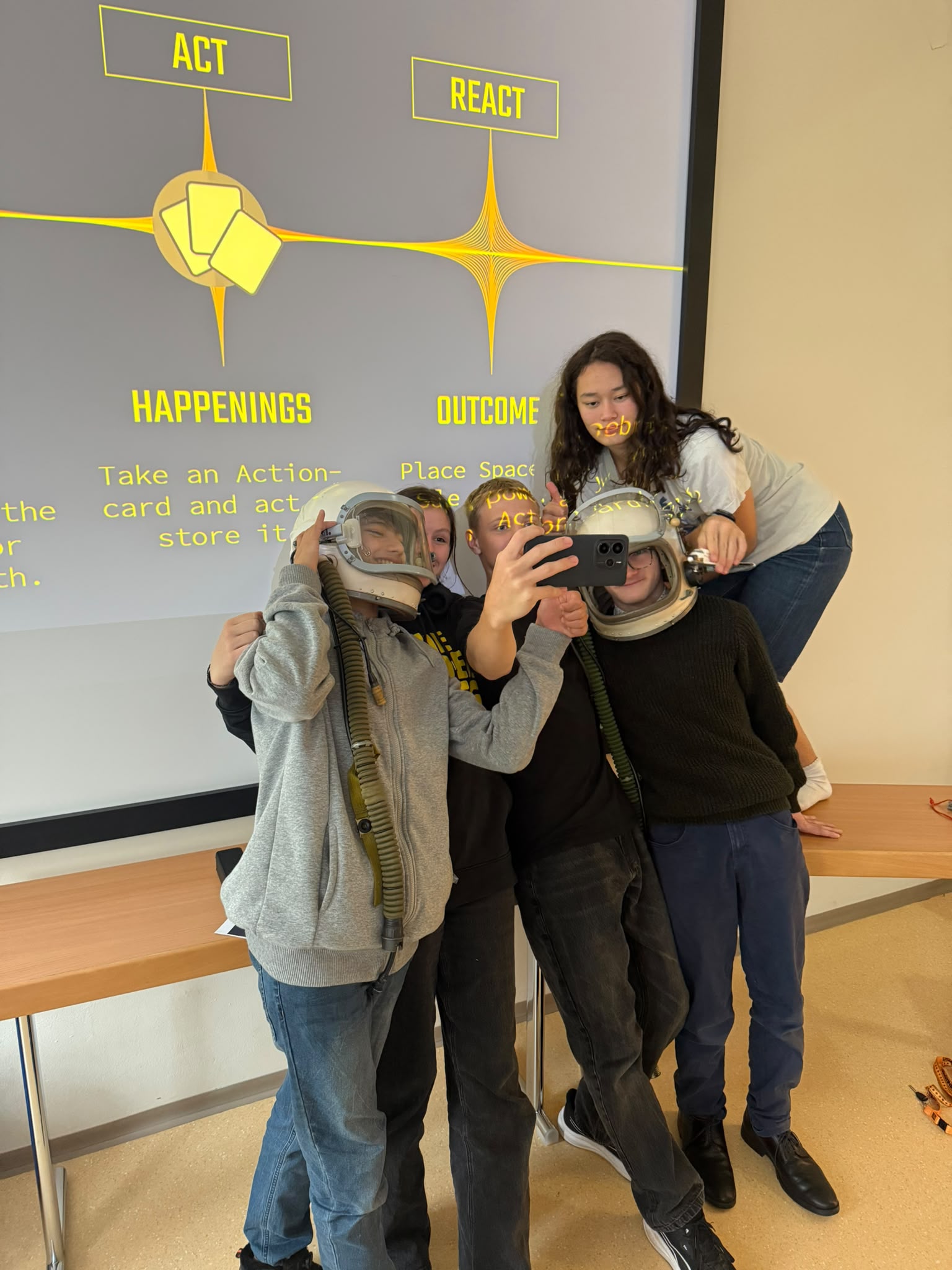
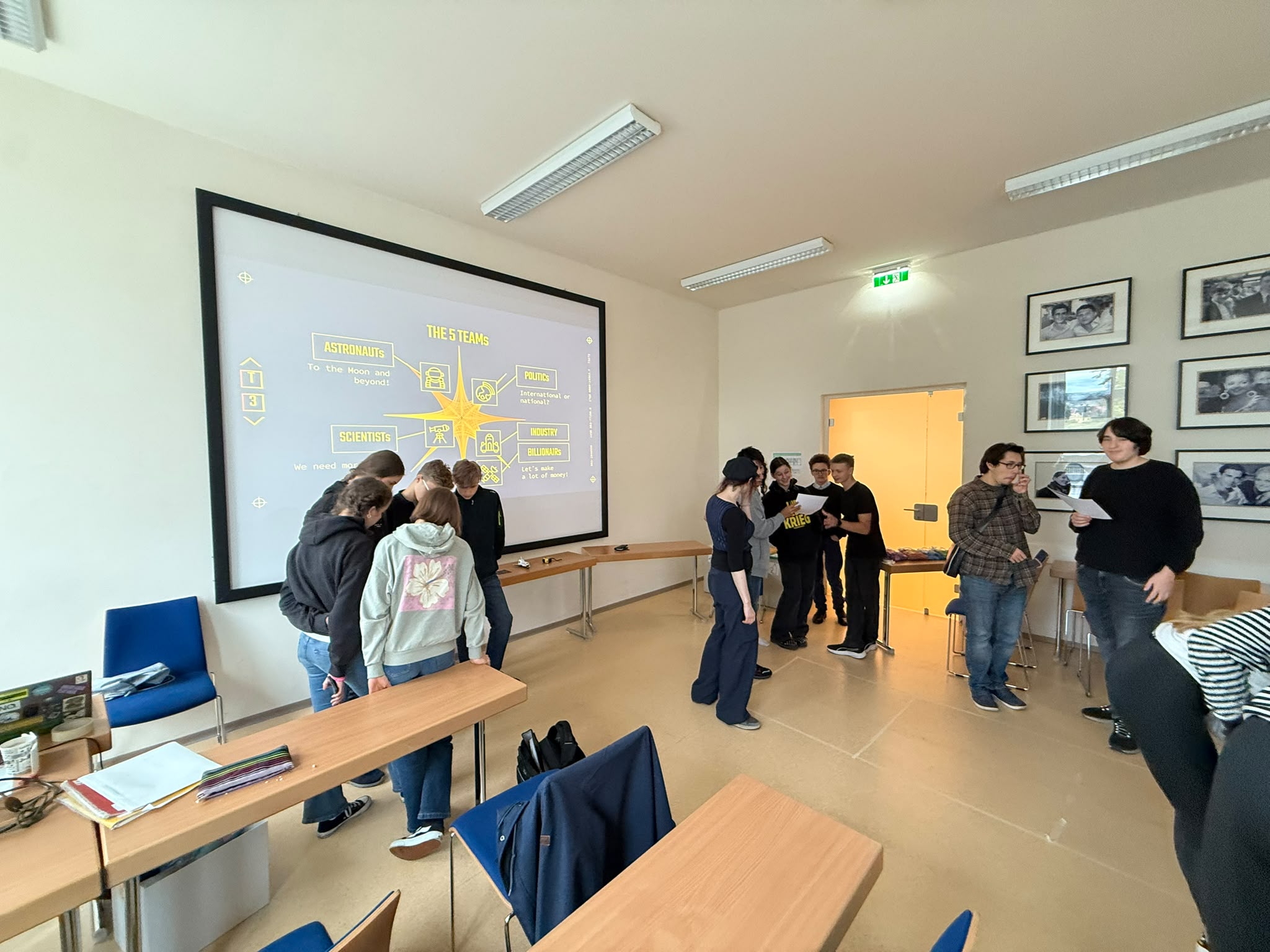
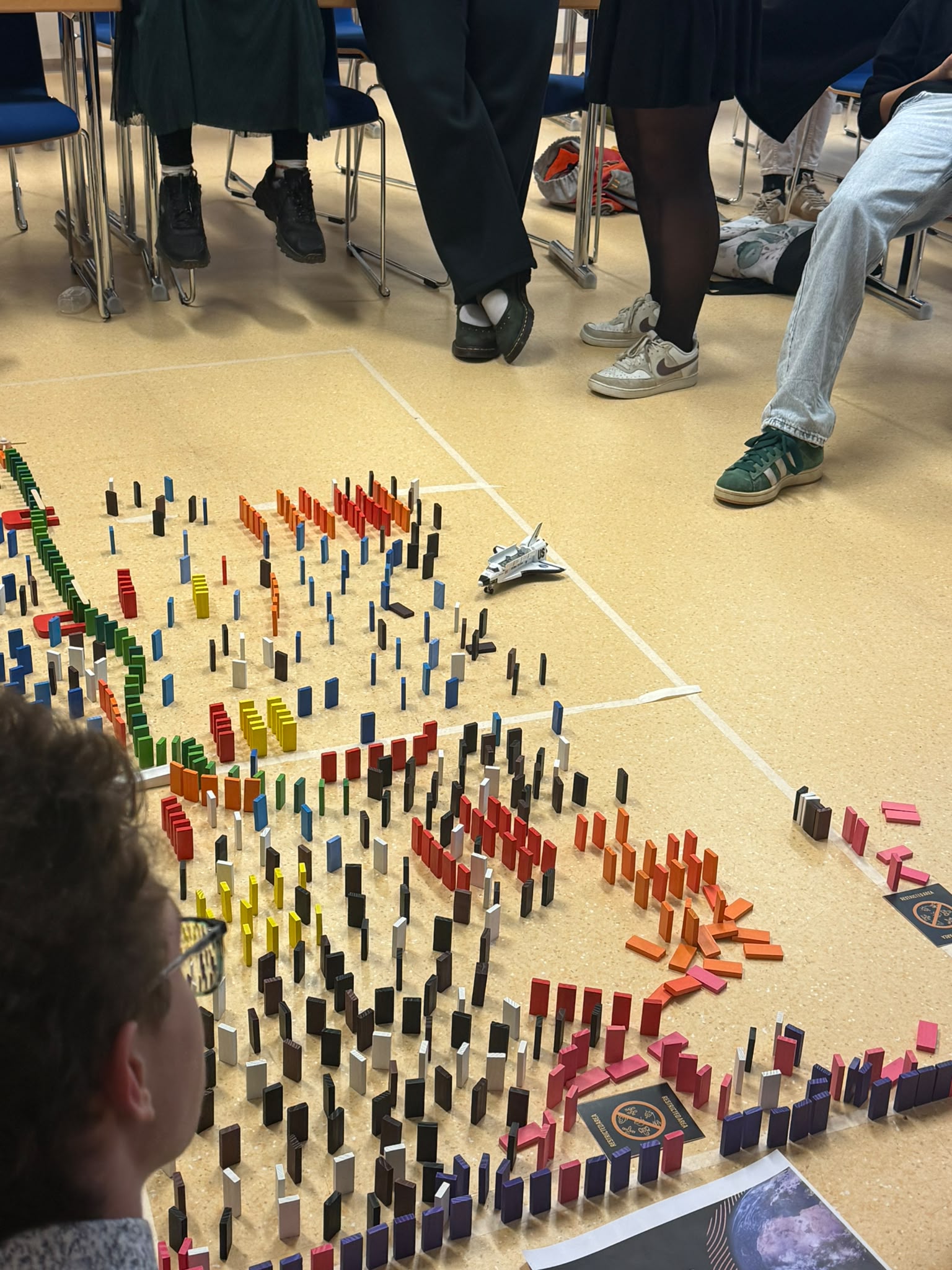
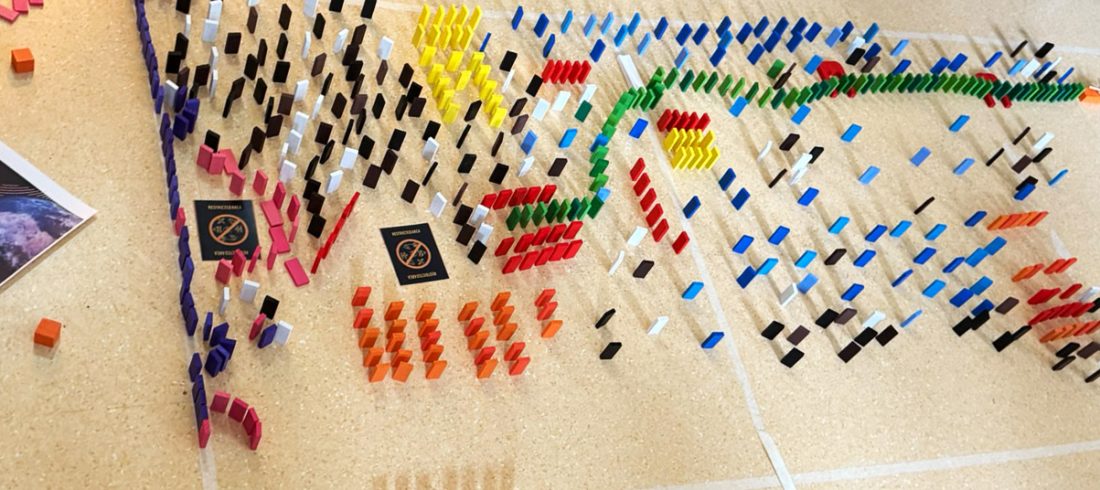
Am Nachmittag spielten wir ein Planspiel und finden heraus, ob wirklich genug Platz im Weltraum ist. Wir wurden in mehrere Gruppen geteilt. Astronauten, Politiker: innen, Billionaires, Wissenschaftler: innen, Militärdienste und weitere. Jede Gruppe hatte verschiedene Aufgaben und Möglichkeiten in Spielzügen, und jeweils eine Mission, die aber den anderen nicht bekanntgegeben werden durfte.
Es gab die Astronauts, deren Mission es war, ihr Spacecraft, ohne eines von anderen Gruppen gelegtes Objekt zu beführen, auf die andere Seite des Spielfeldes zu befördern. Für jede Erfolgreiche Reise, wurden ihnen eine gewisse Anzahl an Punkten zugeschrieben.
Andere Gruppen, wie die Billionaires zum Beispiel, konnten bestimmte Anzahlen an Satelliten und Stationen beliebig auf dem Feld aufstellen. Ihr Ziel ist nicht, es die Astronauten zu stoppen; nur ihre eigene Mission zu beenden.
Technisch gesehen müsste nichts in Konflikten enden. Jedoch wurde sehr einfach und effektiv gezeigt, dass Keine der Gruppen auf die anderen hätte achten müssen, um ihre Aufgabe zu erledigen. Jedoch wurde schnell klar, dass ohne Verhandlungen und Kommunikation, der Prozess für alle Beteiligten schwieriger, und beinahe unmöglich werden würde.
Ziel des Spieles war es, wie schon erwähnt, herauszufinden, ob im Orbit genug Platz für alle ist. Es wurden Regeln aufgestellt und Kompromisse und Allianzen geschlossen. Jedoch wurde nach einer Zeit herausgefunden: Müssen wir uns an die Regeln halten, wenn es keine Executive gibt, die diese Regeln und Abmachungen kontrolliert und für Konsequenzen sorgt?
Vielen Dank an alle unterstützenden, und die Vortragenden!
Über die Autorin:
Juno Legat, 14 Jahre alt. Besucht das Bundesgymnasium Babenbergerring. In der Freizeit spielt sie Geige, ist Pfadfinderin bei der Gruppe Gloggnitz, und beschäftigt sich mit Quantenoptik und diversen anderen Themen.
The 7th workshop, held on Saturday, October 10, 2026, was a two-part session. The first half consisted of an informative presentation on the current state of our space environment.
The speakers, Juliana Neuhuber and Judith Delany, discussed how the amount of space debris has evolved over the years and what the future holds if we do not come up with a solution—and fast.
Juliana Neuhuber grew up at Altpernstein Castle in Upper Austria. A director and screenwriter, she works as a filmmaker and interactive storyteller, focusing on mixed-media projects within the fields of STEM, space, and history. She develops narratives, videos, and puzzles for escape rooms, apps, and games, and collaborates with Corebreaker Labs to create gamified hardware and software products.
In 2010, she founded her company, Traum & Wahnsinn, followed in 2022 by the IT and data visualization firm Impressive Space Development. Her clients have included the European Space Agency (ESA), the Vienna Technical Museum, and the Austrian Research Centre for Forests. She is also a member of the Austrian chapter of Women in Aerospace Europe.
Judith Delany is a space communication expert and ecosystem builder. She combines a degree in journalism and media communications with an MA in International Relations—specializing in space law and policy—to increase the visibility of the space sector and foster better connections among its various stakeholders. She has served as Marketing Director for the EMEA region for „For All Moonkind,“ CEO and founder of Perihelion (a creative agency for the space sector), and is a founder and board member of the Austrian chapter of Women in Aerospace Europe.
The Presentation
During the morning session, we explored the topics of „sustainability in space,“ „space traffic management,“ and the „Kessler effect.“ We were shown a video illustrating how significantly the amount of space debris orbiting Earth has increased in recent years, the reasons behind this, and how it is that more and more fragments end up drifting around.
Beyond the obvious cause—humans launching satellites, measuring equipment, and similar items into orbit—there is the constant occurrence of existing debris breaking apart or colliding with one another. You can think of it like radioactive decay: pieces keep breaking down further, becoming impossible to bring back under control—at least not with the tools or methods we have today, especially since no one has even attempted to find a solution, let alone test or implement one.
The rapidly growing number of objects, which vary greatly in size, pose a danger to all functional equipment within range—such as the ISS, satellites, scientific instruments, future missions, and so much more.
About 100 years ago, things were much simpler. Earth was still an „undiscovered“ sphere in the universe, and the space surrounding it seemed infinitely vast. There was hardly any need for rules, as there were very few actors involved.
The Simulation Game
In the afternoon, we took part in a simulation game to find out whether there really is enough room in space. We were divided into several groups—astronauts, politicians, billionaires, scientists, military personnel, and others. Each group had specific tasks and options for their moves, as well as a private mission that could not be disclosed to the other groups.
For instance, there were the astronauts, whose mission was to navigate their spacecraft to the other side of the playing field without encountering any objects placed there by other groups. For every successful mission, a certain number of points were awarded.
Other groups, the „Billionaires,“ for instance, were permitted to place a specific number of satellites and stations anywhere on the field. Their objective was not to stop the astronauts, but simply to complete their own mission.
Technically speaking, there was no inherent reason for conflicts to arise. It became clear, however, in a very simple and effective way that while no group strictly needed to consider the others to accomplish its own tasks, the process would become significantly more difficult—if not nearly impossible—for everyone involved without negotiation and communication.
As previously mentioned, the goal of the game was to determine whether there is enough room in orbit for everyone. Rules were established, and compromises and alliances were formed. Yet, after a while, a question emerged: Are we truly obligated to follow the rules if there is no executive authority to enforce them or impose consequences for breaking them?
Many thanks to everyone who provided support, and to the speakers!
About the author:
Juno Legat, 14 years old. She attends the Bundesgymnasium Babenbergerring. In her free time, she plays the violin, is a scout with the Gloggnitz group, and explores topics such as quantum optics, among others.